Viburnum opulus Hedge Plants Description
Also known as the Snowball Tree, due to its frothy white flowers, Guelder Rose makes a beautiful ornamental hedge. Later in the year, the red berries that accompany Guelder Rose's warm autumnal colours are relished by birds, especially bullfinches and mistle thrushes.
It is a self-pollinating species, so although Guelder Rose can be a single plant in a mixed hedge, having multiple plants will provide the best fruiting. Guelder Rose can be combined with other
native hedging species to prove year round interest, or other flowering species for a
stunning mixed hedge.
Growing up to 5m high with an average growth between 20cm - 40cm per year, Guelder Rose hedging grows well in most soil types - except for very acidic types - but will particularly thrive in moist, fertile soil. Ideally, it should be grown in sunlight, but it is also suitable for lightly shaded areas.
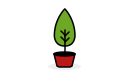
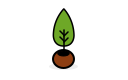
Bare root Guelder Rose hedging plants are available from November to mid/late May, whilst pot-grown and cell-grown plants are available all year round.
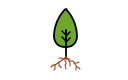
Planting distances are very much a matter of choice - for bare roots, 3 plants per metre is adequate, 5 is good, 7 in a double staggered row will give a dense hedge quicker. Generally, smaller plants should be planted at higher density. Cell grown should be planted at 4 per metre in a single row or ideally 6 per metre in a staggered row.
For more information on planting distances please see our
planting density advice section.
Viburnum opulus is one of a number of plants that produces flowers and berries on last year's stem growth. A healthy plant will produce new stem growth each year quite happily requiring little pruning and maintenance. Trimming however, is sometimes required to maintain or to improve the shape of your plant or hedge.
The ideal time to do this is after flowering in late spring. Ensure that any dead, diseased or broken branches. are removed as part of the process. In addition, to keep a good air circulation which helps to prevent disease, look for and trim out any overcrowded branches. Up to a third of the shrub can be trimmed out yearly if necessary without any negative impact.
Trimming flowering branches back at the tips will naturally impact on berry production that autumn, however the upside is that new growth will develop throughout the remainder of the year on which an abundance of flowers and berries will then be produced the following year.
For old, overgrown plants that have slowed in their flower production and have a leggy, woody appearance, regenerative pruning can be undertaken. This is where old wood is significantly cut back almost to the ground, with particular care taken to remove any weak or straggly branches. This allows the plant to re-establish itself with renewed vigor and growth in subsequent years to become a stunning specimen once again.
This type of hard pruning is best done later in the year but before winter so that some new growth can establish prior to the plant becoming dormant. This will ensure that it bounces back again the following spring.
Free delivery is available on most orders (except Premium Products) providing they meet the minimum spend criteria for the size of box or pallet. Pallet deliveries and large box deliveries for tall plants are indicated by icons on the product table listings. Delivery costs and minimum order details for each packaging type are as follows:
| Packaging Type | Standard Delivery Charge | Minimum Order Values (incl VAT) for FREE Delivery |
|---|
| All Boxes (Bare roots and pots up to and incl. 7.5L) | £7.99 delivery charge (orders up to £60incl VAT) | Orders of £60 and over - FREE |
| Pallets (Root balls, large pots (10L+), trees etc) | £60.00 delivery charge (orders up to £350 incl VAT) | Orders of £350 and over - FREE |
| Pleached Trees (Specialist Delivery) | £450.00 delivery charge (orders up to £1500 incl VAT) | Orders of £1500 and over - FREE |
There are some exceptions to the standard delivery pricing structure, which relate to deliveries to more remote areas, overseas, or extremely tall or large plants requiring specialist delivery - for more information see the Delivery Information Page. (Please note that due to new Brexit rules, we are currently unable to export to both Northern Ireland and the Republic of Ireland.).
Delivery Time - Please note that delivery times are currently 2-7 days excluding bank holidays. *Some troughs, trees and premium products may take up to 14 days delivery. We are working through existing orders as quickly as possible to deliver new orders within this timescale.
It's Convenient - no need to wait in all day to sign, we don't need a signature (the odd, larger order may require a signature but will be delivered at a mutually agreeable time).
It's Tried & Tested - we use only couriers who have shown consistency in their efficiency & care.
* Please note that delivery costs are based on the final order amount in your cart after any discounts have been applied.
Hedges Direct 12 Month Plant Guarantee
Our plants are guaranteed for 12 months after delivery subject to specific criteria. Visit our Hedges Direct Plant Guarantee Page for full details.
Nominated Day Delivery
Choose a delivery day that suits you with our new Nominated Day Delivery option at checkout. Whilst our standard no signature delivery means you don't need to take time away from other committments to receive your order, we understand that there are times our customers want to make sure they are present to accept delivery, either to plant straight away or to store somewhere safe and out of the way until you're ready to plant.
For an additional fee, you can make sure that your order arrives on the exact day you want it. Please note that this is additional charge to all qualifying orders, including those above the free delivery threshold for Standard Delivery.
Our Nominated Day Delivery is available year-round on the weekdays Tuesdays to Fridays, excluding the day after any bank holiday.
Some products are sent direct from our suppliers and as such are not available for Nominated Day Delivery. These include:- Cell Grown Hedging Plants- Instant Trough Grown Hedging Plants- Instant Hedging Screens- Premium Root Balls (250cm and above in height)- Turf
To book your Nominated Day Delivery for farther ahead than the delivery window available online, please contact our Sales & Advice team to discuss your options.


-Flower.jpg "Viburnum opulus")
-Flowers.jpg "Guelder Rose (Viburnum Opulus) Flowers")
-Berries.jpg "Guelder Rose (Viburnum Opulus) Berries")
-Leaf.jpg "Guelder Rose (Viburnum Opulus) Leaf")
-Leaves.jpg "Guelder Rose (Viburnum Opulus) Leaves")
-Flower.jpg)


-Flowers.jpg)
-Flowers-2.jpg)
-Berries-and-Leaves.jpg)
-Leaf-Close-Up.jpg)