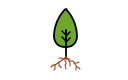
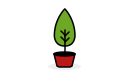
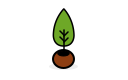
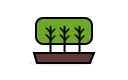
For those who've never bought a new hedge before, there's a myriad of new terminology to get to grips with. In this section we attempt to explain in simple terms the key differences between the 5 main ways that hedge plants are sold.
Alternatively you can see the difference in this short video
Bare Root Hedges
Basically, what you are buying with bare roots is a really good root, with the appropriate amount of stem and side shoots depending on the age (indicated by the height) of the plant ordered. Because they are generally deciduous, they tend to look disappointingly bare (exceptions to this are the evergreen species of Laurel, Yew, Holly, Privet and Box which keep their leaves (or most of them) even as bare roots, and the semi evergreens Beech and Hornbeam).
Whilst the deciduous species are generally pretty bereft of leaves, some of the evergreen species are just fantastic, with very large roots and loads of stems/leaves. Box is a good example - it's a fraction of the price of pot grown but almost as bushy.
Bare roots have the tremendous benefit of being very low cost. They are much cheaper to grow because they are planted only once and can then be left in the fields for several years rather than re-potting each year. They are also cheaper to deliver because we do not have to pay for the weight of the soil. They are extremely popular because you get such a lot of plants for your money and particularly if you have a long length of hedging to do, or you want taller plants, they are well worth considering. There is though a certain failure rate - generally about 10% - (slightly more for Beech and Purple Beech) although you can improve the success rate to virtually 100% by planting with Rootgrow, and it's worth bearing in mind that smaller plants are easier to establish.
If you have never ordered bare roots before, please don't be too nervous of them, we sell hundreds of thousands of plants each year and we know that customers are delighted with the quality and the price. A huge proportion of our bare roots are UK grown from UK seed just a few miles from our despatch centre. The soil is light, sandy soil which is ideal for growing in this way and by growing close to our base, we minimise the amount of time that the plants are out of the soil so that they reach you in great condition.
We recommend our customers take advantage of the very low cost of bare root plants by planting a double staggered row which will give good density. You could also consider having a few spares in a corner of the garden - they'll grow at the same rate as the new hedge and if you have some gaps where an occasional plant has failed, you can pop in one of your spares and it'll be same height and bushiness as the rest of the hedge. Abracadabra!
Bare root plants are only supplied when they are completely dormant, from early/mid-November and most sizes are available until mid-late May (exact dates depend on the weather). Plants used at the end of the season are put into cold store perfect conditions when they are deeply dormant in mid-Winter, to allow the extension of the season without detriment to the success rate, providing they are planted quickly on arrival and, as with all new hedging, kept well watered. Box bare root is the exception - it can be lifted in mid October through to April.
Planting early in the season (ie. before Christmas) gives the roots the best chance to establish whilst there is still some warmth in the soil, ready to put on maximum spring growth. Bare roots ideally need to be planted pretty quickly after arrival. We pack them securely inside our own cardboard boxes to avoid desiccation, (some may be packed in bags if part of a pallet delivery), but on receiving, if you aren't immediately ready to plant your bare roots, you can store them temporarily until you are ready to plant, in a sheltered place like a shed or garage (but not a greenhouse).
If storing, we'd recommend moistening the roots and then storing in thick black bin liners. This will help retain moisture within the roots, keeping them fresh until ready to plant. Ideally you should plant them within a few days - or "heel them in" altogether into one hole pending permanent planting. You will get full preparation and planting guidance when you order or you can read it in advance on our How to Plant Hedging page.
Between July and November each year we build up several thousand "pre-orders" for bare roots and they take priority with delivery so if you do want delivery in November (which is the absolute best month for planting) you will need to pre-order. On all pre-orders we give the benefit of the previous season's prices as well as guaranteeing an early delivery slot.
We have a standard Mixed Native Hedging Packor you can select your own mixture or use the list of species in the Bare Root Hedging section to add additional species to a Mixed Native Hedging Pack.
Cell grown plants are an intermediate step between small bare root and small pot grown plants. They don't have the root development and stem bulk of plants grown in 2 Litre (or larger) pots, but on the other hand, they are inexpensive. They are suitable for planting most of the year yound. Each year we sell over 100,000 cell grown plants with tremendous results - they really do catch up with bigger container grown plants very quickly.
Cell grown plants are supplied with roots intact (unlike bare roots) so there is no loss of the fine feeding roots and root hairs which often carry friendly fungi - as a result, they have a high success rate with good uniformity. We sell cell grown plants in minimum quantities of 12 per species. Prices are shown for individual plants, discounted packs of 30, 50, 100, 250 and 500 plants and we can give even bigger discounts for quantities of over 500 plants. For large projects (eg forestry or woodlands) please ring us on 01257 263 873 for a quote on wholesale rates. All our cell grown plants are UK grown.
These are one step up from cell grown plants but not as big as what we describe as pot grown plants. Their little pots measure 7cm or 9cm and in the trade they are called P7s and P9s - they're a bit bigger than a yogurt pot. We do several species grown in this method and we list them under the species headings and also under Cell Grown (because they really are very similar to Cell Grown plants with just a slightly bigger root). Because they are small plants with strong root systems, they are hugely successful - we find customers are delighted with the growth they get in the first few years - they soon catch up to plants in bigger pots if you plant at the beginning of a growing season. All our P7 and P9 plants are UK grown.
However, they are not as bushy as a pot grown in a 2 litre pot (basically a lot of our 2 litre stock started a season or two earlier as a P7 or P9) - we try hard to make sure that our plants - whichever growth method is used - give value for money so the more expensive pot grown plants are bigger. Our sales team can advise which root style would be best for your requirements.
3. Full Size Pot Grown Hedge Plants
We sell evergreens, semi-evergreens and deciduous pot grown plants and the vast majority of them are UK grown. Growing in pots requires much more input from us with watering, weeding, feeding and annual re-potting. However, they have a very high success rate because the roots remain completely protected by the pots until customers re-plant them whereas inevitably there is some root damage to bare roots and root balled plants in the process of lifting them from the fields and delivery. Pot grown plants can be left in their pots for days or even weeks before being planted into the ground, providing they are kept watered.
We always indicate what size pot the plant is in and this is given to indicate to customers the maturity of the root structure from which comes the bushiness of a plant. So a Cherry Laurel at 100cm tall grown in a 4 litre pot will have bigger, more mature roots than the same height of plant grown in a 2 litre pot, and therefore the upper growth will be much bushier. It's a case of "you get what you pay for". There's a photograph on our website in the section "Advice on pot sizes" which shows how the bushiness of a plant increases with bigger pot sizes.
Just to give you an idea of what's involved in growing a plant in a 2L pot, it will be 2 to 4 years old (depending on growth rate) and will have been re-potted up to 3 times, trimmed up to 5 times, fed regularly, weeded a couple of times and watered daily!
Some websites don't make it absolutely clear what you're getting. We're aware that some of our competitors sell "plugs" or plants in P9s and describe these as container grown or pot grown - nothing wrong with either but they're not comparable with 2 litre pots which is our minimum on all species except some of the compact varieties like Lavenders. Some competitors are even more dubious - and sell by pot size but don't give a plant height - you'd be very disappointed with a 20cm plant in a 2 litre pot compared with our 60cm plants in the same pot size. They might both be advertised as 2 litre pot plants but ours would be much better value.
Please make sure when you're comparing prices on websites that you take the pot size into account and that you know for certain what height of plant you are going to receive. All our heights are quoted from the top of the pot upwards i.e. the height it will be when planted.
Many evergreen plants are sold as root balled, particularly large plants. They are grown naturally in a field (often for many years) and when ready for delivery, they are scooped out of the ground by a machine, which cuts a ball around the root which is then wrapped in a biodegradable hessian sack or a wire contraption (for the larger plants), both of which are left on the plant when planted and both decompose naturally.
Root balled evergreens are cheaper than pot grown evergreens (due to the lower cost involved in this growing method) - and particularly when customers are looking for tall, bushy plants, this is a very economical way to establish a new hedge. We do not grow these plants ourselves, they come from Holland where there are specialists, and we have chosen a grower who grows absolutely top quality plants. We take a very thin margin on these plants so that we remain competitive. We have a comprehensive photograph library so if you would like to see before you buy please just ask us for a photo.
Root balled plants are only available from late October to April - the success rate (which is good but not as good as Pot Grown) is enhanced if they are re-planted into their permanent positions before Spring arrives and planted with RootGrow. Customers who order root balled plants should ensure that they can plant out within a few days of delivery. We cannot stress enough the importance of keeping large evergreens well watered and you should absolutely drench the planting hole and then drench again after planting and regularly (sometimes the winter weather helps!) throughout the whole of the first year after planting. Sometimes, root balls (particularly those over 1.5m) can defoliate or suffer from yellowing leaves when the first hot weather arrives in the first season after planting - this is just the plant being shocked by the heat and it merely needs plenty of water to help it to recover.
Planting later in the season (March/April) is riskier than planting early in the season October/November/December) and the risk increases with the height of the plant i.e. a 2.0m plant planted in March has a higher risk than a 1.0m plant planted in March. Equally it has a higher risk than a 2.0m plant planted in November. RootGrow helps a lot but even RootGrow won't help a plant find water if there has been no rainfall and you don't water them sufficiently. You'd think it wouldn't happen when people pay a lot of money for lovely plants but we know otherwise!
Between July and October each year we have built up several hundred "pre-orders" for root balls, and they take priority with delivery so if you do want delivery in late October/November (which is the absolute best time to plant) you will need to pre-order. On all pre-orders we give the benefit of the previous season's prices as well as guaranteeing an early delivery slot.
So, whether it's bare roots, cell grown, P9s, pot grown or root balls, we have plants for all budgets and all requirements. If you would like advice on which growing method would be best for you, please feel free to speak to our experienced sales team on 01257 263 873.
Instant Hedging Guide
Because of the regular trimming in both width and height, our instant hedging is comparatively more mature than a pot grown plant or root ball plant of the same height. If you're looking for show garden quality hedging, you've found it. The cost of this growing method is higher than more conventional methods, so if your budget does not permit instant, trough grown, pre-trimmed hedging, then have a look at our root ball page (root balls are mature, heavy plants but untrimmed), or consider tall, pot grown or bare root plants. You may also be interested in our Ivy Screens which have a similar, instant effect. Our sales team will willingly give advice on how best to achieve the effect you are seeking within your budget - please call us on 01257 263 873.
Here are the key points that we think you need to know when ordering pre clipped instant hedging:
1. Ordering
We use the terms "young troughs" and "mature troughs" to describe our instant hedging. Young troughs will be younger and less bushy, whilst mature troughs will be older, have received extra specialist nursery attention and will be bushier. So be guided by this also and not height alone.
Heights specified are the minimum you will receive and are taken from the top of the trough. We don't heavily prune our instant hedging unless we need to (for example seasonally) so when you receive your plants they may be a bit bushy, ready for you to prune to your desired height if required.
We know we're cheaper than our competitors and would like to reassure you that inexpensive instant hedging is our objective. Because it is highly specialised some growers have margins that we think are excessively high whereas we always aim to give great value for money, so please don't be concerned that our plants are not as good as more expensive instant hedging, feel free to ask for a photograph of the actual troughs you would receive.
2. Quality
Our specialist growers use a growing medium which is light enough to make the troughs manoeuvrable but contains all the nutrients and goodness that the several plants in your trough will need.
All instant trough grown pre trimmed hedging is irrigated and fertilised regularly so that it is in the best possible condition when it arrives with you.
We use a varying quantity of plants in each trough depending on species as we know what will create the perfect hedge unit - this is usually 4 to 5 plants.
Quite a lot of instant hedging is "field grown" or grown in very long troughs and then cut into unit lengths for despatch (not ours!). This means that the cut edge does not have foliage on it, which is ok if you are butting another length of hedging up against it but is often not ok for the ends! Additionally there is also the risk that the machine that cuts the lengths could cut too close to a main stem, or could split a main stem and whilst unsightly the greater concern is that splits in stems can allow disease to enter a plant especially when it is stressed by being moved - our method of growing intact plants into ready prepared troughs ensures no root or branch damage to instant hedging.
We use only high quality plants in our instant hedge troughs; it is this, along with our years of expertise that gives us a fantastic success rate, top quality products and great prices.
3. Delivery & Planting
Instant hedging troughs can either be rigid plastic or heavy duty hessian troughs with handles at both ends. We do both types but favour the hessian troughs because they make the stock lighter for you to move into the planting position
All the troughs we supply can be moved by two fit people, be careful buying instant hedging elsewhere because some is so heavy that forklift trucks are needed to move them.
Planting instant hedging is very easy and efficient, because the plants are ready spaced out for you. Just prepare your planting trench to the right depth (easy to measure when you have the hedging on site but generally about 30cm for all species other than Box where it's a bit less), measure out the required amount of RootGrow (which we strongly recommend), and then lift the whole hedging unit out of the trough and position in the trench. Backfill, firm in and water in well.
The success rate of new instant hedging is very high because any weaker plants will have been removed from the troughs and replaced within it's first year - well before the hedging reaches you ready for the ground.
We hope that the above information is sufficient for you to understand and make your root type choice but if you have further queries or would like to look at different options for your planting requirements, our sales team will be more than happy to assist. Please do call on 01257 263 873 or email [email protected]
Show more >>>
Show less <<<
Root Types Summary
×
Bare Roots
Field grown, bare roots are young plants that are only planted when they are dormant, from autumn to spring. We lift bare root plants and despatch them during the season but they can be pre-ordered in summer. As they are cheaper to grow, they are one of our most affordable hedge planting options.
Pot Grown
Pot grown plants can be planted year round and make a convenient option. They come in a wide range of sizes, from 10cm to 2.5m so they're suitable for the majority of planting requirements.
Root Ball
Also field grown, root ball plants are scooped out of the ground using machinery to keep their root system intact and wrapped in bio-degradable, hessian sacks. They are mature plants that provide dense coverage very early on, ideal for when you need a thick hedge quickly.
Instant Hedging
Grown in troughs or bags that measure 50cm-1 metre in length and carefully clipped during the growing season. Our instant hegding troughs create a dramatic, instant hedge effect.